In short
- Underneath, AI runs on tokens, small pieces of text. If you build your own agents, you pay for every token the model reads and writes. If you buy from a vendor, you may be charged per user, per task or per outcome instead, but tokens still drive the vendor's costs, and so your price.
- Agents cost far more than chat because they re-read everything, including any document you give them, at every step.
- The same quality of AI keeps getting cheaper, but bills have not fallen, because top models cost almost as much as ever and agents use so many more tokens.
- Costs are unpredictable, and spending more does not reliably buy better results.
- Before approving a budget, ask what a successful result costs and who carries the risk when a task uses more tokens than expected.
I have been curious about token economics for a while. This weekend I finally spent some time, despite the beautiful weather in Melbourne, reading the research, because I wanted to understand what is actually happening across the industry.
The reason was personal. I use an artificial intelligence (AI) coding tool in my day-to-day work. For a long time it ran on a subscription: one flat fee each month. Then it switched to usage-based pricing, where you pay for what you consume. On the first day, I uploaded a medium-sized Word document, the kind most of us write every week, and asked the tool to work with it. Before the day was out I had used up my whole allowance, and the tool stopped working for me.
I had not done anything unusual. So what exactly was I paying for, and why did it run out so fast?
First, what is a token?
Many of you will already know, but it helps to see one. AI models break text into small pieces called tokens. Short words are usually one token; longer words get split, and punctuation counts too. Roughly:
I | uploaded | a | document | and | my | tokens | ran | out | on | day | one | .
That is 12 words and about 13 tokens. The exact split varies by model; you can try it on OpenAI's free tokenizer page. As a rule of thumb, 1,000 words is about 1,300 tokens.
Tokens are the unit that AI model providers charge in, whether you pay them directly or a vendor pays them on your behalf; one recent survey calls them the basic economic unit of agentic AI. But not all tokens cost the same:
| Type of token | What it is | How it is usually priced |
|---|---|---|
| Input | Everything the model reads | The base rate |
| Output | Everything the model writes | Several times the input rate |
| Cached input | Text read recently and reused | Often about a tenth of the input rate |
| Cache writes | Storing text for reuse (some providers) | A small premium on input |
| Reasoning | The model's hidden "thinking" | Usually charged as output, though you never see it |
Some providers also charge extra for very long inputs or for tool use, such as each web search.
Why agents use so many tokens
A chat is one exchange: the model reads your question once and writes an answer. An agent works through a task in steps. It reads the task, uses a tool (searching files, running a test), reads the result, decides what to do next, and repeats. The catch is that at every step, it re-reads everything that has happened so far.
Every step re-reads everything before it
The pile of text the agent reads grows with every step. Source: Bai et al. 2026.
Put a document in that loop. A 10,000-word document is about 13,000 tokens. A chat reads it once. An agent that takes 30 steps can read it every time: around 390,000 tokens before writing a single useful word. That is an illustration, not a measurement, but it is the shape of what happened to me.
The research backs this up. A University of Michigan and Stanford-led study of eight leading AI models fixing 500 real software bugs found that an agent used about 1,200 times more tokens than a back-and-forth chat about code. Not because agents write more, but because they keep sending the same material back to the model. A Concordia University study of a team of AI agents found that reading made up more than half of all tokens; writing only dominated during the coding itself.
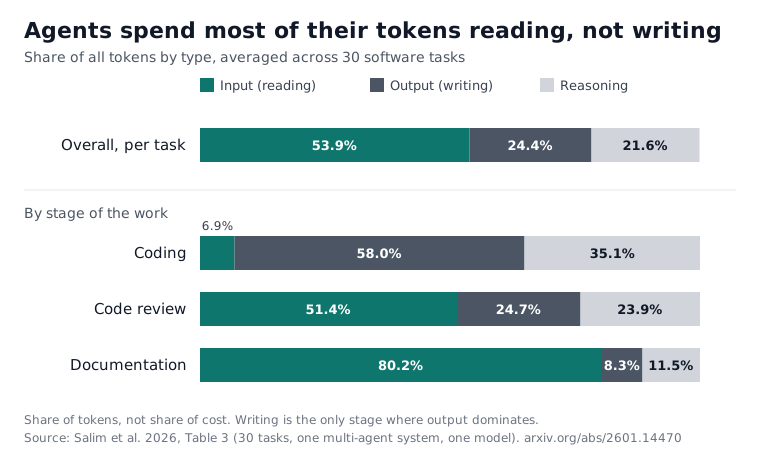
Share of tokens, not share of cost. Source: Salim et al. 2026, Table 3 (30 tasks, one multi-agent system, one model).
Caching helps, but in the Michigan and Stanford study those cheap repeat reads were still the biggest part of the bill. A tiny price multiplied by an enormous volume is still a big number. One caution: nearly all of this evidence comes from coding agents, so your numbers will differ.
If tokens are getting cheaper, why are bills going up?
It depends on what you compare. If you hold quality fixed, AI has become much cheaper: getting the same quality of answer as a few years ago now costs a fraction of what it did. Epoch AI, an independent research group, estimated that this price fell by 9 to 900 times a year up to early 2025, depending on the task. MIT FutureTech, using a stricter method that also counts the extra tokens newer models use, put it at a more modest 5 to 10 times a year. But if you compare the best model then with the best model now, the picture is very different. Here are OpenAI's own published output prices as of September 2026:
| Model | Price of 1M output tokens at launch |
|---|---|
| GPT-4 at launch (March 2023) | $60.00 |
| GPT-6 Astra, newest flagship (September 2026) | $50.00 |
| GPT-5.6 Sol, previous flagship | $30.00 |
| GPT-5.6 Terra, mid-range | $12.00 |
| GPT-5.6 Luna, fast and cheap | $1.20 |
The cheapest current model writes at one-fiftieth of the 2023 price. But look at the top of the table: the newest flagship costs almost as much as GPT-4 did three and a half years ago, and more than the flagship it replaced. Older levels of quality get dramatically cheaper; the very best stays expensive. So why do bills often go up instead of down?
- The best models use far more tokens. Researchers at MIT FutureTech found that while a given level of quality got 5 to 10 times cheaper each year, the cost of running the best available model rose by 3 to 18 times a year, because top models are bigger and do much more reasoning.
- Agents multiply every token. A cheaper token read a thousand times is not cheap.
- Costs are unpredictable. Running the same agent on the same bug four times, the most expensive run typically cost about double the cheapest, and in extreme cases up to 30 times more. The expensive runs were not better, just full of the agent re-opening the same files. When asked to estimate their own token use in advance, every model came in too low.
Think of it like petrol getting cheaper while you swap a small car for a truck and drive ten times as far. The price per litre falls, but your fuel bill still goes up.
That explains my day one. The tool was almost certainly working in steps, carrying my document along and re-reading it each time. Under a flat subscription I never saw that; under usage pricing it showed up on the first day. It also explains the pricing change: a flat fee works for chat because most people use roughly the same amount, but agents do not.
What to do about it
Design what the agent reads
What an agent reads is a design choice, not a side effect. Decide what it can pull in (a whole file, or just the relevant part?), what it carries forward from step to step, and when it should stop and hand back to a person. This matters even more when several agents work together: in the Concordia study, agents reviewing each other's work used 59.4% of all tokens, while writing the first version used just 8.6%.
Understand how the vendor charges you
If you buy an agentic solution, you may never see a token on the invoice. Vendors charge per seat, per conversation or transaction, per action or credit, per successful outcome (such as a resolved support ticket), or a mix of these with a platform fee.
Underneath every one of these, the vendor is still paying for tokens. The charging model simply decides who carries the risk when a task needs far more tokens than expected. Per token, you carry it. Per outcome, the vendor carries it, and prices that risk into the fee. Bessemer Venture Partners' AI pricing playbook says the same from the seller's side. Pricing is also moving fast: one of the largest business software vendors has changed its agent pricing model three times in about 18 months.
Questions to ask before you approve a budget
- What is the billing unit, and what counts as one? Who decides when a task is complete?
- Are failed or escalated tasks charged?
- What does a successful result cost, including the failed attempts?
- What did repeated pilot runs show? Ask for the typical and worst-case cost, not a single estimate.
- What happens if our volume doubles, or the vendor changes its pricing model mid-contract?
Lessons learned
The evidence is young and mostly from coding agents, so use it to understand the shape of the problem and your own pilot runs for the numbers. Agents behave less like a flat subscription and more like a utility bill. Budget per successful outcome, expect a range rather than a single number, and design what the agent reads as carefully as what it does.
Sources
- Bai, L., Huang, Z., Wang, X., Sun, J., Mihalcea, R., Brynjolfsson, E., Pentland, A., Pei, J. (2026). How Do AI Agents Spend Your Money? Analyzing and Predicting Token Consumption in Agentic Coding Tasks. Preprint (version 2, April 2026). arxiv.org/abs/2604.22750 (PDF)
- Salim, M., Latendresse, J., Khatoonabadi, S., Shihab, E. (2026). Tokenomics: Quantifying Where Tokens Are Used in Agentic Software Engineering. Preprint, submitted January 2026; not yet formally published, so treat it as unreviewed. Authors describe their findings as preliminary, based on 30 tasks with one framework (ChatDev) and one model. arxiv.org/abs/2601.14470 (PDF)
- Chen, Y. et al. (2026). Token Economics for LLM Agents: A Dual-View Study from Computing and Economics. Preprint, survey. arxiv.org/abs/2605.09104 (PDF)
- Cottier, B., Snodin, B., Owen, D., Adamczewski, T. (2025). LLM inference prices have fallen rapidly but unequally across tasks. Epoch AI data insight. epoch.ai/data-insights/llm-inference-price-trends
- Gundlach, H., Lynch, J., Mertens, M., Thompson, N. (2026). The Price of Progress: Price-Performance and the Future of AI. MIT FutureTech. Preprint (version 2, March 2026); an earlier version appeared at a NeurIPS 2025 workshop. arxiv.org/abs/2511.23455 (PDF)
- Bessemer Venture Partners (2026). The AI pricing and monetization playbook. bvp.com/atlas/the-ai-pricing-and-monetization-playbook
- OpenAI (2026). GPT-6 Astra: A new generation of intelligence. openai.com/index/gpt-6-astra
- OpenAI. API pricing. openai.com/api/pricing (prices change often; checked September 2026)